
Grok 3 vs Claude 3.7 Sonnet: The Ultimate Coding Speed & Performance Showdown for Developers in 2025
2025 hit different. AI assistants aren’t just tools anymore—they’re teammates, and for devs, that’s both exciting and terrifying. If you’re writing Python at 2 AM, debugging Node.js APIs, or cranking out React components, your choice of AI can make or break your workflow. Enter Grok 3 Vs Claude 3.7 Sonnet—two giants, two philosophies.
Grok 3 screams speed, raw computational firepower, and real-time data magic. Claude 3.7 Sonnet whispers precision, structured thought, and code you can actually ship without constant patching. Choosing between them? It’s like deciding between a nitro-fueled race car and a Swiss watch: one gets you there fast, the other ensures you arrive in one piece.
In this showdown, we’re breaking it down: speed, accuracy, latency, developer tools, and real-world performance. Strap in—this is Part 1, where we focus on understanding the models, technical benchmarks, and coding performance.
Understanding the Models
What is Grok 3?
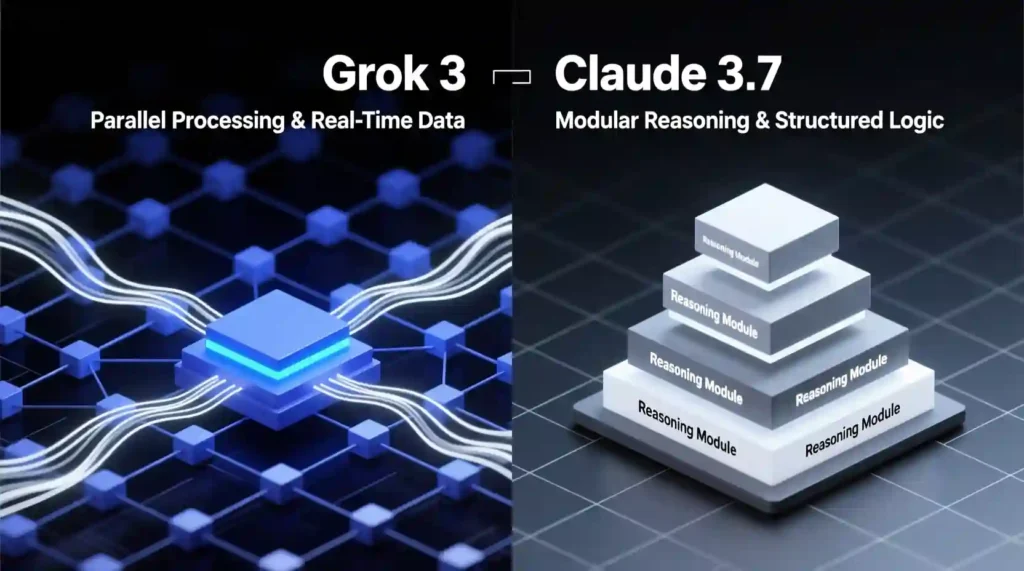
Grok 3, built by xAI, is chaos wrapped in a framework of sheer computational power. 1.5 petaflops. Massive parallelization. 128,000-token context window. It’s a beast built for STEM-heavy, high-speed environments.
Key Features:
- DeepSearch: Live, real-time data from the web and the X platform. Your code can reference APIs or datasets as they update.
- Big Brain Mode: Toggle this for heavy math or logic queries—it’s like giving your AI a Red Bull.
- Context Window: 128k tokens. Massive. You can feed entire repos, documentation, or multi-file projects in one go.
- Focus: STEM reasoning, real-time analysis, and rapid prototyping.
Grok isn’t gentle—it’s designed to fire out code fast, crunch numbers hard, and overwhelm the problem before you’ve even fully formulated it.
What is Claude 3.7 Sonnet?
Claude 3.7 Sonnet, by Anthropic, is the opposite end of the spectrum. It’s deliberate, precise, and human-friendly. It doesn’t just throw code at you; it ensures the code is readable, maintainable, and bug-resistant. Think of it as a senior engineer who won’t stop until your PR passes with flying colors.
Key Features:
- Hybrid Reasoning: Quick responses when you need them. Deep thinking when you’re tackling multi-step, complex problems.
- Coding-Centric Design: Optimized for bug fixes, refactoring, and multi-file workflows.
- GitHub Integration: Pull requests, code reviews—directly in your workflow.
- Context Window: 128k tokens. Long codebases are no sweat.
Claude is the safety net, the reliability, the model that won’t make you regret hitting run on production.
Technical & Performance Benchmarks
Coding Speed
Grok 3:
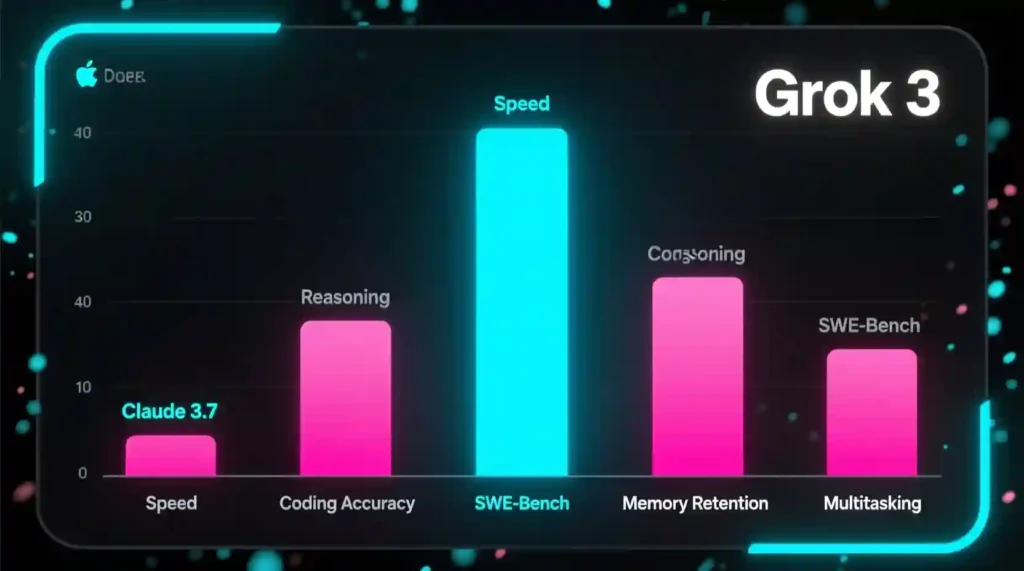
- Reported 25–30% faster token-per-second output than previous iterations.
- Rapid first draft generation dominates in scientific scripts and algorithm-heavy tasks.
Claude 3.7 Sonnet:
- Standard mode is fast, but Deep mode introduces a slight delay.
- Produces higher-quality output, reducing time spent debugging errors.
Takeaway: Grok wins the raw speed game. Claude wins efficiency when total workflow time is considered.
Accuracy & Reasoning
| Benchmark | Grok 3 (MMLU/AIME) | Claude 3.7 Sonnet (SWE-Bench/MMLU) | Key Takeaway |
|---|---|---|---|
| Advanced Reasoning (MMLU) | ~92.7% | 80% | Grok dominates academic reasoning tasks. |
| Math Problem-Solving (AIME) | 93.3% | N/A | Grok excels at complex quantitative challenges. |
| Coding (SWE-Bench Verified) | N/A | 70.3% | Claude dominates real-world bug fixing and software engineering tasks. |
Grok is a math and science monster. Claude is a code perfectionist.
Coding Problem Benchmarks (LiveCodeBench)
- Grok 3: ~80.4% success rate. Fast, diverse, and adaptable across multiple languages.
- Claude 3.7 Sonnet: Slightly lower raw success, but produces cleaner, more idiomatic, and modular code.
Quick tip: If you’re feeding in messy prompts or experimental libraries, Grok gets it out fast. Claude makes sure it stays usable for your team.
Latency
- Grok 3: Average latency 67 ms. Big Brain or Think mode adds deliberate pauses.
- Claude 3.7 Sonnet: Low latency in Quick mode, Deep mode slows down first token but reduces revisions later.
The difference? Grok feels like a live wire; Claude feels like a senior dev taking a considered pause before delivering perfection.
Developer-Focused Features
| Feature | Grok 3 | Claude 3.7 Sonnet |
|---|---|---|
| Processing Power | 1.5 petaflops, 2.7 trillion params | High, optimized for coding workflows |
| Context Window | 128k tokens | 128k tokens |
| Coding Assistance | Real-time code generation, debugging help | Full-stack support, GitHub integration |
| Reasoning Style | Stepwise Thought Chain (visible) | Hybrid reasoning (Quick & Deep modes) |
| Access | X Premium+ subscription | Pro, Team, Enterprise plans |
| Additional Tools | DeepSearch, Big Brain Mode | Extended Thinking Mode, Claude Code CLI |
| Energy Efficiency | 30% lower consumption | Improved computational efficiency |
| Pricing | $30–$40/month | Similar tiers in Anthropic plans |
Real-World Coding Tests
Sample Tasks:
- Complex Algorithm Generation: Python graph traversal with constraints.
- Frontend React Component: Fully functional modal with state management.
- Full-Stack Debugging: Node.js off-by-one error detection and unit test generation.
Outcomes:
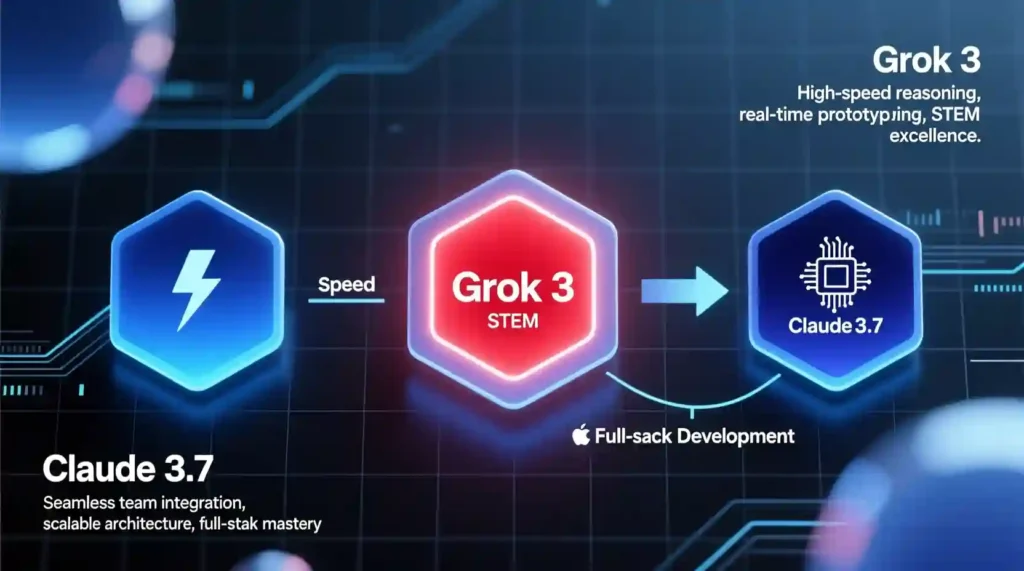
- Grok 3: Wins speed. Fast first drafts. Excels in scientific computation and real-time API integration.
- Claude 3.7: Wins workflow efficiency. Cleaner code, fewer runtime errors, better parsing of complex instructions.
Grok: “Here’s a working script—good luck refining it.”
Claude: “Here’s a polished, modular function ready to merge.”
User & Developer Feedback of Grok 3 vs Claude 3.7
Claude 3.7 Praise:
- Fewer iterations needed for bug fixing.
- Preferred for refactoring legacy code and large PRs.
Grok 3 Praise:
- Blazing speed for prototyping.
- Stepwise Thought Chain helps understand complex algorithms.
Challenges:
- Grok 3: Mode toggling can disrupt flow; advanced tasks can slow down.
- Claude 3.7: Deep mode slows repetitive workflows.
Use Case Recommendations
Choose Grok 3 if:
- You’re heavy on STEM, simulations, or ML.
- Real-time data integration is critical.
- You need rapid scripting and prototyping.
Choose Claude 3.7 Sonnet if:
- Code maintainability and structure are priorities.
- You’re managing full-stack projects or multi-file workflows.
- GitHub PRs and large team collaboration matter.
Future Outlook
Both models are evolving. Grok is likely to lean further into multimedia and live code agents. Claude will refine hybrid reasoning for tighter latency and automated workflows. The trend is clear: future devs will use both—speed from Grok, quality from Claude.
Real-World Coding Challenges
When it comes to live coding, benchmarks only tell part of the story. The user experience—how the AI feels in your IDE, your terminal, or on mobile—makes all the difference.
Grok 3
- Hyper-responsive, almost too fast at times.
- Feels like a live assistant that keeps tossing code while you blink.
- Great for rapid script generation, prototyping, and STEM-heavy coding tasks.
- Real-time data integration through DeepSearch means APIs, datasets, or libraries are up-to-the-minute current.
Claude 3.7 Sonnet
- Feels like a thoughtful mentor who pauses, considers, then delivers perfect code.
- Deep mode slightly delays first token but reduces revisions later.
- Produces clean, idiomatic, modular code ready for production or PR submission.
- Tight GitHub integration makes it perfect for team workflows, code reviews, and full-stack projects.
Bottom line: Grok is the “speed demon,” Claude is the “senior engineer.”
Latency & Mobile-Friendly Workflow
Developers increasingly work across laptops, tablets, and even phones. Latency impacts mobile workflows heavily:
- Grok 3: Average 67 ms in rapid mode. Ideal for quick edits, testing scripts, or live coding sessions on mobile.
- Claude 3.7: Quick mode is responsive; Deep mode adds 0.5–1 s delay but reduces follow-up corrections. Better for structured work on-the-go where clarity matters more than raw speed.
Both models support long-context files (128k tokens), so reviewing large repos on mobile or tablet is feasible without chunking.
Community & Developer Feedback
Real-world insights are messy, human, and invaluable. Reddit threads, GitHub discussions, and dev communities paint the picture:
Claude 3.7 Praise:
- Fewer attempts to fix bugs—saves time in full-stack projects.
- Preferred for PR reviews and refactoring legacy code.
- Its clean code output reduces developer stress—less mental load juggling messy scripts.
Grok 3 Praise:
- Incredible speed—first drafts almost instantly appear.
- Stepwise Thought Chain helps understand complex algorithms.
- Ideal for research-heavy tasks requiring real-time data.
Challenges Recap:
- Grok 3: Mode toggling can disrupt the workflow; Big Brain mode latency can frustrate those expecting instant results.
- Claude 3.7: Deep mode slows repetitive tasks; may feel overcautious for quick scripts.
Use Case Summary Grok 3 vs Claude 3.7
| Use Case | Best Model | Why |
|---|---|---|
| STEM/Math-heavy tasks | Grok 3 | Superior reasoning scores (AIME 93.3%), real-time data integration. |
| Rapid prototyping & scripts | Grok 3 | Speed-first output with minimal setup. |
| Full-stack development | Claude 3.7 Sonnet | Clean, modular code with fewer runtime errors. |
| Team PR reviews | Claude 3.7 Sonnet | Native GitHub integration and structured output. |
| Large repo navigation | Both | 128k token context window allows massive codebases. |
| Mobile coding workflow | Claude 3.7 Sonnet | Thoughtful output reduces repeated corrections; Grok 3 is fast for quick edits. |
Pricing & Accessibility
- Grok 3: $30–$40/month via X Premium+. Good for individual devs or small teams seeking speed.
- Claude 3.7 Sonnet: Pro, Team, Enterprise tiers. More structured pricing with team-friendly options.
Both models are cost-effective compared to hiring human assistants for continuous code support, making AI adoption in dev workflows increasingly mainstream.
Future Outlook
The AI coding space is evolving fast:
- Grok 3: Expected to lean into multimedia, real-time data pipelines, and possibly a dedicated “Code Agent” AI. Ideal for devs needing rapid experimental output.
- Claude 3.7 Sonnet: Will likely refine hybrid reasoning, adding granular control over thinking budgets for automated pipelines. Perfect for maintainable production code.
Key Trend: Future developers will likely combine both: Grok for speed and immediate insights, Claude for quality, structure, and team-ready code.
Conclusion — Which AI Should You Choose?
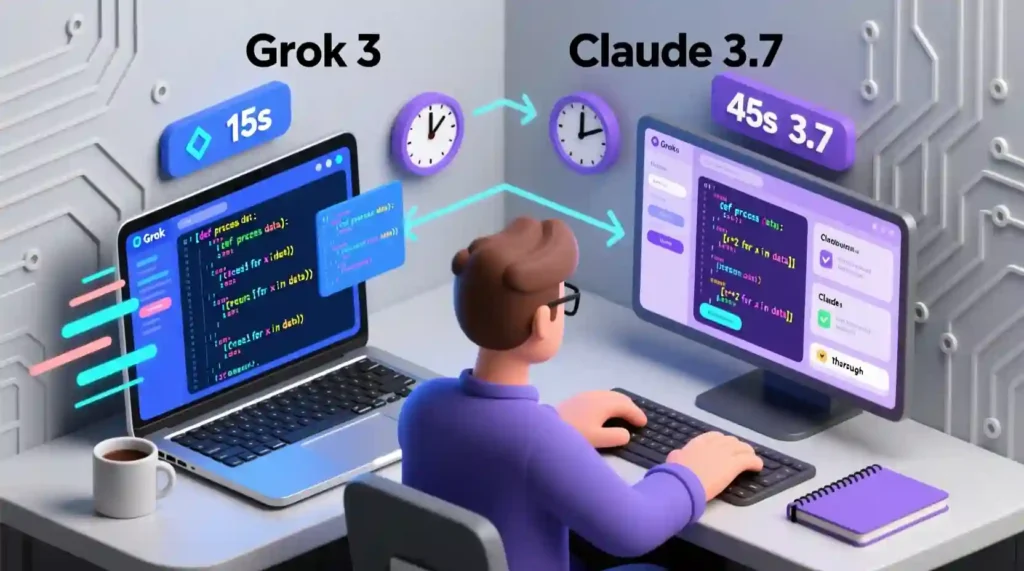
Here’s the messy, human truth: choosing between Grok 3 vs Claude 3.7 Sonnet isn’t about picking a winner—it’s about picking the right tool for your brain, your workflow, and your deadlines.
- Grok 3 is the high-octane race car: you feel the adrenaline, the speed, the instant answers. Perfect if you live in STEM problems, rapid prototyping, or real-time research. Sometimes chaotic, sometimes brilliant, always fast.
- Claude 3.7 Sonnet is the precision-engineered luxury vehicle: deliberate, thoughtful, reliable. Fewer errors, cleaner code, smoother collaboration. Ideal if you value maintainable code, full-stack workflows, and sanity while managing large teams or repos.
On mobile or desktop, the experience mirrors this philosophy: Grok for rapid-fire edits, Claude for structured, deep work that feels like a human mentor is sitting next to you.
The real magic? Use both. Fire up Grok when speed matters. Switch to Claude when code quality, clarity, and team collaboration matter. That’s how you win in 2025: not by picking a single AI, but by integrating speed and precision into your coding rhythm.
FAQ
What’s the key difference in coding?
- Grok = speed, STEM reasoning, real-time data.
- Claude = code quality, structure, hybrid reasoning.
Which is faster?
- Grok raw output is fastest. Claude saves time overall on complex tasks.
Which is better at bug fixing?
- Grok dominates math/logic. Claude wins real-world software engineering tasks.
Can both handle huge codebases?
- Yes, both support 128k token contexts, so no chunking necessary.
What subscriptions do I need?
- Grok: X Premium+
- Claude: Pro, Team, Enterprise
Final Thoughts:
2025 is wild. Developers finally have AI teammates that can think, calculate, debug, and even mentor. Grok 3 and Claude 3.7 Sonnet aren’t competitors—they’re complementary forces. Learn to ride the chaos of Grok and the discipline of Claude, and your coding life will never be the same.
Pingback: Buffer vs Hootsuite AI (2025): Full Honest Comparison - zadaaitools.com
Pingback: Claude Haiku 4.5 vs Sonnet: The Ultimate AI Power & Cost Showdown - zadaaitools.com