
AI localization tools bridging culture & communication
I. Introduction: The Rise of AI Localization
If you’ve ever read a translated ad that made zero sense, you’ve already met the problem AI localization tools are built to solve.
Simple translation doesn’t cut it anymore. It’s like copying someone’s words but missing their soul. That’s where AI localization tools come in — they help brands speak not just in another language, but in another culture’s rhythm, humor, and emotion.
This shift is what marketers now call AI-driven transcreation — the fusion of translation and creativity. Unlike old-school translation software, these systems understand idioms, tone, and even color meanings.
And here’s the business truth: you can’t scale global content anymore without them.
The localization industry grew from $56 billion in 2022 to $75.7 billion in 2025 — a massive 35% jump, mainly powered by neural machine translation and localization automation tools.
In short, it’s not about translating words. It’s about translating feelings.
II. How AI Localization Tools Actually Work
Behind every culturally smart brand today, there’s a powerful mix of AI translation vs localization tech at work.
A. The Core Tech: Language Meets Context
These systems are built on Natural Language Processing (NLP) and Machine Learning models like GPT-4 and BERT that don’t just translate but interpret.
They learn regional patterns like:
- What emotions feel respectful vs aggressive?
- Which slang lands well vs sounds awkward?
- How humor or metaphors change meaning across languages.
This is the difference between saying “You crushed it!” (a compliment in English) and “You destroyed it!” (which sounds harsh in other languages).
That’s why the best cultural adaptation platforms don’t just replace words — they rewrite them emotionally.
B. How AI Becomes a Cultural Filter
1. Emotional & Idiomatic Adjustment
AI localization tools use sentiment analysis to tweak tone. For instance, an ad in Japan may need softer emotional phrasing than in the U.S. — less hype, more harmony.
2. Format & Symbolism
Localization automation handles practical details like:
- Changing imperial ↔ metric units
- Adjusting currency ($ → € / ₹)
- Replacing visuals that clash with local symbolism (e.g., white = purity in the West, mourning in some Asian cultures)
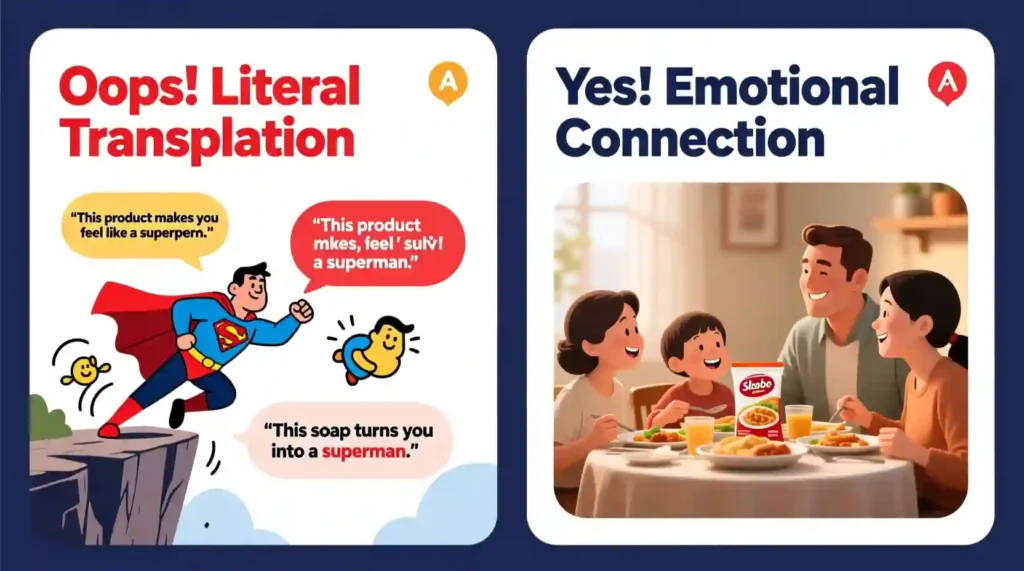
3. Real Example: Coca-Cola
When Coca-Cola launched its “Share a Coke” campaign globally, it used AI to generate 870 culturally relevant names for Japan (instead of the 250 generic ones used before). Engagement? Up 18%.
That’s the power of local emotion meeting global reach.
III. When Translation Fails: Costly Localization Mistakes
Even billion-dollar brands have paid the price of getting it wrong.
A. The Big Blunders
1. Idioms Gone Wrong:
KFC’s “Finger-lickin’ good” turned into “Eat your fingers off” in Chinese markets. The slogan was catchy — just not in the way they intended.
2. Message Lost in Translation:
HSBC’s “Assume Nothing” became “Do Nothing” in multiple languages. The fix? A $10 million global rebranding.
3. Cultural Chaos:
Pepsi’s “Come alive with the Pepsi Generation” was interpreted in China as “Pepsi brings your ancestors back from the grave.” Not quite the vibe.
These aren’t just translation fails — they’re what we now call localization mistakes. Each one shows how easy it is to break trust when you skip cultural context.
B. The Win: AI That Gets the Human Touch
Then there’s the flip side — brands that nailed it.
Example: Airbnb
When Airbnb expanded across Europe, they didn’t just translate copy. They used AI localization tools to adapt landing page stories, photos, and tone to each country’s emotional culture.
A local host story in Spain highlighted family gatherings and warmth.
In Germany, the same page emphasized trust and precision.
The result? 25% higher ROI and a massive boost in organic engagement.
This is what happens when brands treat localization as cross-cultural communication, not just language work.
IV. The ROI of Hyper-Localization
Localization used to feel like a cost. Now it’s an investment.
A. Building Authenticity and Trust
Audiences can smell generic content a mile away. When words and visuals feel local, it instantly creates a connection.
That’s what transcreation software offers — emotional precision that makes a brand feel native.
B. The Numbers That Prove It
Companies using AI localization tools report:
- Up to 60% faster go-to-market for campaigns.
- 2x higher engagement in localized markets.
- Fewer compliance issues, since AI automatically aligns with local norms and legal phrasing.
These are localization ROI metrics that prove real value — not vanity stats.
C. Scale Without Losing Voice
AI makes it possible to handle global content management across dozens of markets while keeping brand voice consistency.
This is key for companies like Netflix, Shopify, and Nike — they need to sound human in every language without losing their identity.
V. Key AI Localization Tools & Players to Know
Here’s where the market gets interesting.
A. Smartling — The Enterprise Workflow Pro
Smartling is a translation management system (TMS) built for huge content operations.
- It connects directly to Contentful, Shopify, and Adobe Experience Manager.
- It helps language service providers (LSPs) manage translation pipelines automatically.
- It reduces manual edits and keeps tone aligned across languages.
In short: Smartling is for scale.
B. Omniscien — The Creative Genius
Omniscien focuses on deep adaptation — rewriting tone and imagery for local emotion.
- Used by L’Oréal in over 50 markets.
- Balances AI translation vs localization with real human review (machine translation post-editing).
- Helps brands preserve their creative voice while still being locally relatable.
This is pure transcreation power — not just automation.
C. LangChain + CrewAI — The Research Brain
These modhttps://python.langchain.com/docs/introduction/els use multi-agent systems for high-stakes content — legal, medical, or government use cases.
- They combine neural machine translation with contextual reasoning.
- Ideal for cultural sensitivity in compliance-heavy industries.
When accuracy and emotion both matter, this setup is gold.
VI. The Future: From Words to Visual Worlds
The next evolution of AI localization tools isn’t just about text anymore — it’s about sight and sound.
Welcome to visual localization.
Imagine TikTok ads that automatically shift background colors, slang subtitles, or even background music based on culture. That’s where we’re heading.
As video platforms dominate 2025, brands need AI that can localize everything — tone, imagery, gestures, humor.
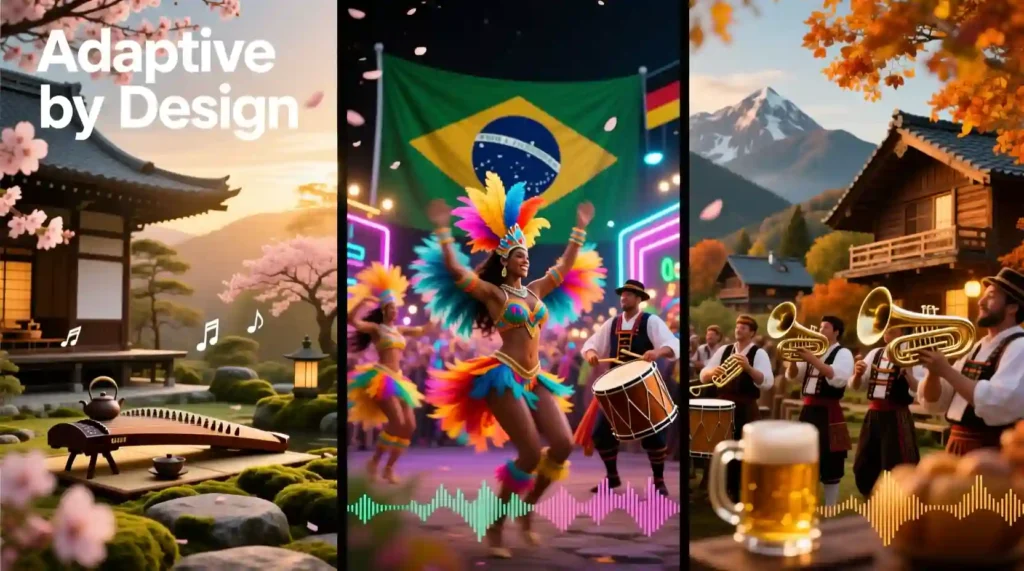
- A commercial in Japan might use pastel tones and soft background piano.
- The same spot in Brazil might feature bold yellows and rhythmic drums.
- In Germany, it might swap out the actors’ expressions to feel more reserved.
That’s multilingual content strategy in its purest form — every frame, every sound, tuned to a local heartbeat.
VII. Why Hyper-Localization Wins
Let’s be honest. People don’t connect with “translated” content anymore. They connect with familiar emotion.
AI localization tools let brands sound human, not robotic — at scale.
They help your message land softly in Japan, boldly in the U.S., and respectfully in the Middle East — all from one source campaign.
When you use cultural adaptation platforms, you stop guessing how people might feel. You start knowing.
It’s not just about selling. It’s about belonging.
VIII. The Final Payoff: Numbers Don’t Lie
Brands that embrace full localization automation are already seeing major wins:
- 25–40% lower content costs from automation and MTPE (machine translation post-editing).
- Up to 2.5x engagement lift on social platforms when language and visuals are localized.
- Faster localization QA cycles thanks to AI-assisted tone consistency.
These aren’t vanity metrics — they’re survival stats for global marketing in 2025.
If your brand voice feels the same everywhere, you’re invisible.
If it feels native everywhere, you’re unstoppable.

IX. Conclusion: From Global Reach to Local Relevance
AI localization tools aren’t just smart tech — they’re empathy engines.
They bridge the gap between what your brand means and how the world hears it.
They help you build real trust across languages, beliefs, and cultures — something no manual translation can ever guarantee.
By now, it’s clear: AI localization is the key to future-proof global storytelling.
It combines AI translation, localization, and transcreation software with brand voice consistency into a single, scalable system that feels uniquely human.
So stop treating localization like a checkbox.
Start treating it like your most powerful growth strategy.
X. Next Steps: Test Your Localization Readiness
You’ve learned what it takes — now it’s time to measure where your brand stands.
👉 Download our 5-Minute AI Localization Maturity Quiz
Discover how ready your brand is for hyper-localization — and identify the cultural risk factors that could compromise trust, engagement, or lead to costly rebranding later.
Because in 2025, it’s simple:
If your brand doesn’t speak culture, it doesn’t speak at all.
Pingback: Devin AI Autonomous Coding Agent Review (2025): Is It Worth $20/Month? - zadaaitools.com